Checklist: Coordinating Packaging Requirements for Medical Products
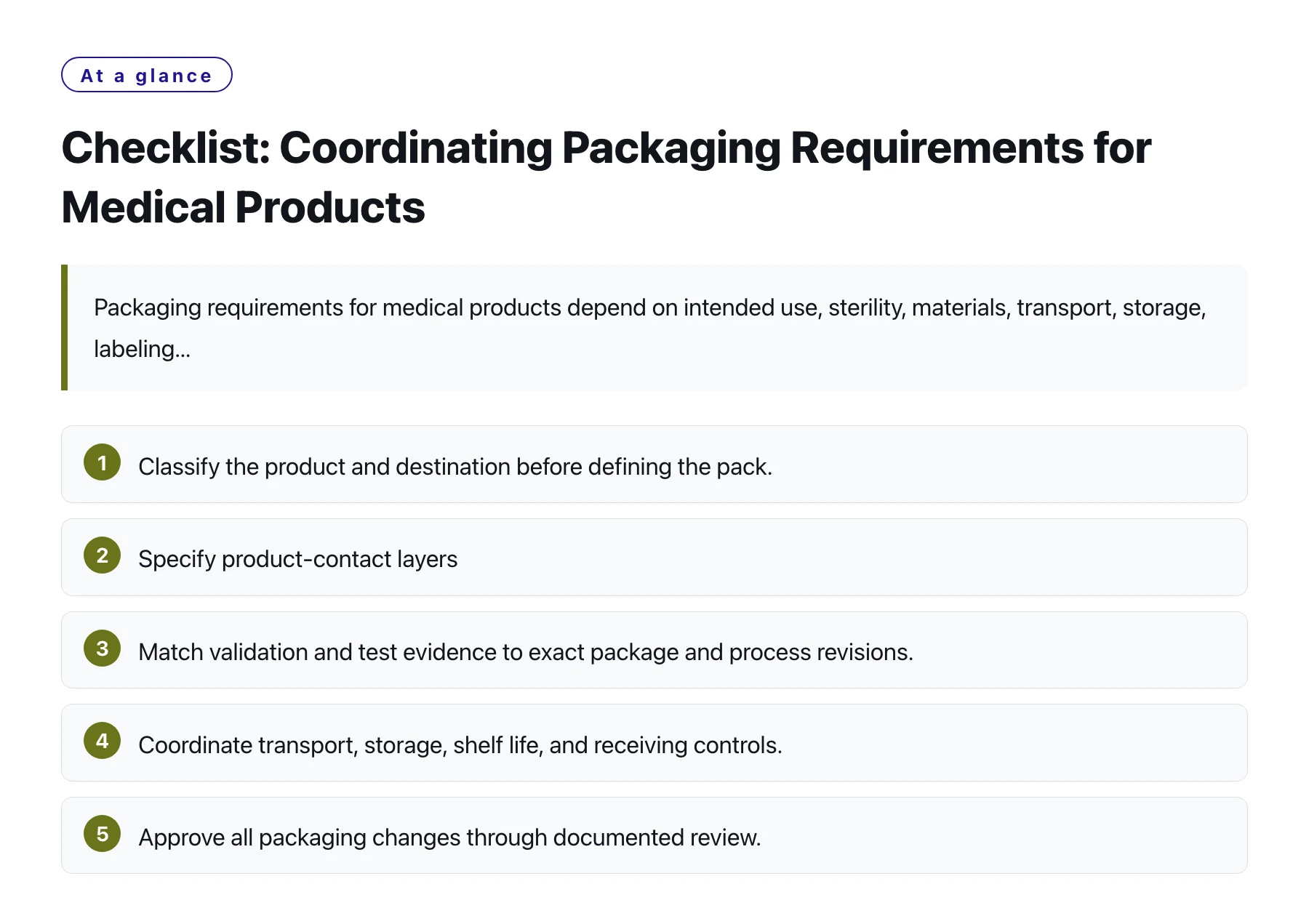
Packaging requirements for medical products depend on intended use, sterility, materials, transport, storage, labeling, and destination market. A checklist should connect the approved product to the exact packaging configuration and evidence. Buyers must assign packaging validation and regulatory decisions to qualified owners instead of relying on a generic “medical grade” claim.
Key takeaways
- Classify the product and destination before defining the pack.
- Specify product-contact layers, sterile barrier, labels, and lot traceability.
- Match validation and test evidence to exact package and process revisions.
- Coordinate transport, storage, shelf life, and receiving controls.
- Approve all packaging changes through documented review.
A documented discovery funnel helps buyers compare relevant evidence and make a decision they can explain.
1. Identify product, use, and market
List product, model, intended use, patient or user contact, sterility status, reusability, accessories, destination, and distribution route. Determine with a qualified regulatory owner whether it is a regulated device or another product category. Requirements vary by product and market.
Define the packaging function: containment, protection, sterile barrier, presentation, information, or a combination. Distinguish the product-contact package from transport cartons and pallets.
2. Describe the packaging configuration
Document each layer, material, dimensions, closure, seal, label, protective insert, shipper, and unit or case quantity. Include supplier, plant, material grade, drawing revision, and critical tolerances where required.
Identify which surfaces contact the product and whether materials could affect cleanliness, compatibility, function, or labeling. If the package changes between local and export distribution, define both configurations.
Record the package’s dimensions, gross mass, components, and assembly sequence. Include a diagram or photograph for a complex pack and identify critical seals or closures. Set how production operators verify the approved setup and what record is retained for each lot.
3. Address sterile products as a specialized case
If the product is sterile, have qualified packaging and regulatory specialists determine the sterile barrier system, sealing method, sterilization compatibility, process validation, and integrity testing needed for the applicable market. Do not infer sterility from a clean-looking pouch or supplier statement.
Tie evidence to the exact material, package design, sealer, production site, sterilization process, and shelf-life claim. Changes to any critical element may require documented reassessment or revalidation before release.
4. Specify labels and instructions
Control product identity, manufacturer, lot or serial, manufacture or expiry date, storage conditions, symbols, warnings, language, and instructions as required for the product and destination. Keep label artwork and package artwork under revision control.
Review labels on the actual package and compare them with the approved file. Confirm barcode readability, print durability, orientation, and visibility after packing. Assign label content approval to the market and product owners.
5. Protect product through transport and storage
Describe temperature, humidity, light, impact, compression, vibration, moisture, contamination, and handling risks relevant to the product. Specify inner restraint, cushioning, moisture barrier, tamper evidence, shipper strength, palletization, and storage limits where needed.
Check package dimensions and mass against warehouse, courier, container, and clinic receiving constraints. If products have a shelf-life limit, define remaining life at shipment and receipt and confirm storage records where relevant.
6. Review validation and test evidence
Ask for packaging drawings, material declarations, test protocols, results, validation summary, acceptance criteria, report dates, sites, and product configuration. Determine whether reports cover sterile barrier integrity, seal strength, distribution simulation, transit protection, or other risks applicable to the item.
A test for one package size or product family may not automatically apply to every variant. Record the rationale for grouping or bracketing and have qualified reviewers approve it. Keep underlying evidence linked to the purchase and manufacturing revision.
7. Align documentation and destination obligations
For products regulated as medical devices, requirements vary by destination. FDA states that foreign manufacturers exporting devices to the United States must meet applicable U.S. requirements, which can include labeling and other product obligations; this overview is U.S.-specific and does not replace product-specific review. [1]
Ask the importer’s compliance owner to confirm the required documentation, responsible parties, language, and records for the target market. Avoid broad supplier claims such as “FDA approved packaging” without a precise legal basis.
8. Control suppliers and packaging changes
Identify packaging-material makers, converters, sterilizers, label printers, and contract packers. Clarify supplier qualification, incoming checks, change notification, lot traceability, and retention samples. Determine who approves new raw materials or subcontractors.
Require written review for a change to material, seal dimensions, adhesive, supplier, process, print, transport configuration, or factory. Identify which tests, approvals, and documents need updating and hold affected goods until review is complete.
Retain the old specification and approval history so the team can determine which lots used which package. If a change is rejected, define how the supplier prevents obsolete materials and artwork from being used in a later order.
9. Use a coordinated checklist
Checklist fields can include product and market, package layer, drawing revision, material, critical dimensions, process, label, evidence, test, storage, lot identity, owner, approval, and change trigger. Separate applicable, not applicable, pending, and rejected decisions.
Buyers coordinating JS Sourcing can use one checklist with manufacturers and packaging suppliers, while assigning validation, regulatory, and final acceptance decisions to qualified owners. At receipt, verify label, package condition, lot, and required documents before distribution.
Sources
Frequently asked questions
Does every medical product need sterile packaging?
No. Sterility depends on the product and intended use. A qualified regulatory and technical review should set the package function and evidence.
Can a packaging test report cover every product variant?
Only if a qualified reviewer confirms the tested configuration and any grouping rationale cover those variants.
What should a packaging checklist include?
Record product, market, package layers, materials, labels, process, evidence, traceability, storage, owners, and change triggers.
Does FDA guidance apply to every destination?
No. FDA import requirements are U.S.-specific; confirm rules for the actual product and target market.