Pumps, Caps and Crimping: Where Perfume Bottles Actually Fail
A fragrance can be perfect and still fail at the shelf because the pump drips, the cap will not seat, or the crimp loosens in transit. These are component and assembly problems rather than perfumery problems, and they are decided months before the filling line runs. The buyers who avoid them are the ones who treat the pump, the collar and the crimp as a single system rather than three catalogue items.
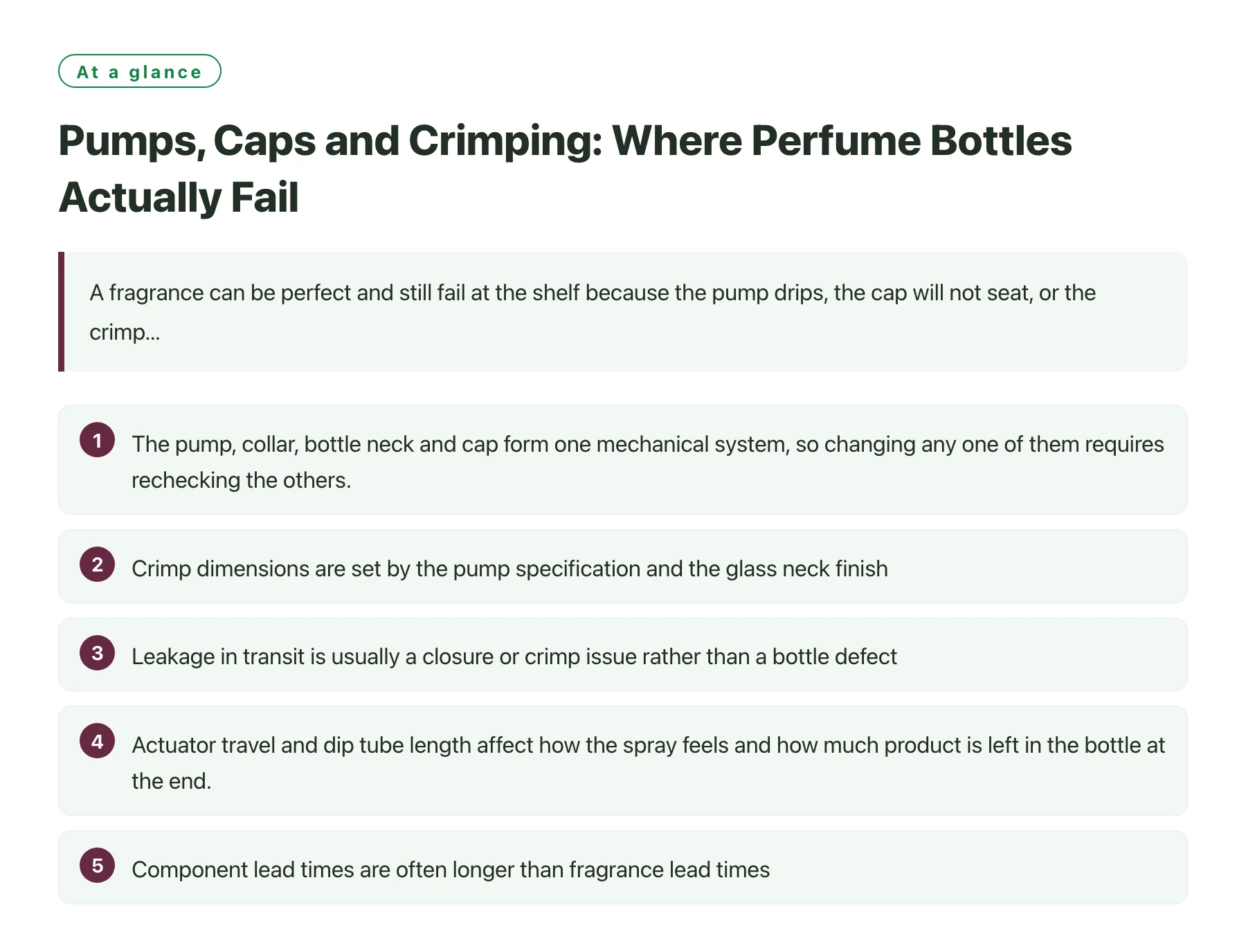
Key takeawaysThe pump, collar, bottle neck and cap form one mechanical system, so changing any one of them requires rechecking the others. · Crimp dimensions are set by the pump specification and the glass neck finish, and they must match rather than be adjusted on the line. · Leakage in transit is usually a closure or crimp issue rather than a bottle defect, and it is testable before the bulk run. · Actuator travel and dip tube length affect how the spray feels and how much product is left in the bottle at the end. · Component lead times are often longer than fragrance lead times, which makes packaging the real driver of the launch date.
Ask a quality team where fragrance products fail and the answer is rarely the juice. It is the pump that does not prime, the cap that sits a fraction of a millimetre proud, or the crimp that holds during filling and lets go somewhere between the factory and the warehouse.
None of these failures are exotic. They come from mismatched specifications, from components approved in isolation, and from a filling line being asked to compensate for an incompatibility it cannot fix.
This article covers the three components that cause most of the trouble, the mechanical step that joins them, and the checks that catch problems before they are multiplied by a production run.
How to specify and verify the closure system
- Start from the glass neck finishThe neck finish is the fixed geometry of the bottle, and every pump and collar choice has to be compatible with it before anything else is decided.
- Match the pump to the productViscosity, alcohol content and target dose per spray all influence which pump mechanism is suitable, so the pump is chosen from the formula rather than from a photo.
- Confirm the crimp specification in writingCrimp height and diameter come from the pump supplier and are not open to improvisation on the filling line.
- Check cap clearance with the collar fittedA cap that clears the pump on a bench may foul once the collar is crimped, so the fit must be checked as an assembly.
- Ask for leakage and drop testingThird-party laboratories routinely test closures for leakage, compatibility and transport performance as part of packaging qualification [1].
- Verify a full production sampleTake units from the start, middle and end of the run and check spray performance, crimp appearance and cap seating on each.
The three components and what each one decides
It helps to separate the closure system into three parts, because each one drives a different kind of problem and is specified by a different party.
The pump sets dose, feel and finish
A pump determines how much liquid leaves the bottle per actuation, how fine the mist is and how the spray feels in use. Those are the sensory properties customers notice first, and they are fixed by the mechanism rather than by the formula.
Dip tube length matters more than it appears. A tube that stops short leaves product stranded at the bottom of the bottle; one that touches the base can draw air as the level drops.
The cap is a fit problem, not a decoration
Caps fail in two ways: they do not seat cleanly, or they loosen in transit. Both are clearance issues between the cap, the collar and the shoulder of the bottle.
Tolerances in glass and in moulded caps are both finite, so a design that works at nominal dimensions can fail at the extremes. Ask to see the fit checked on bottles from more than one production batch.
The collar carries the crimp
The collar is the part that is deformed onto the pump to hold it in the bottle. Its material and wall thickness decide how the crimp behaves under pressure and over time.
A thin or brittle collar can crack during crimping, and the failure may not appear until the bottle is handled or shipped.
The single most useful rule in this part of a project is that the closure system should be approved as an assembly, on real bottles, before the bulk order is placed. Approving a pump from a sample card, a cap from a render and a bottle from a glassworks catalogue leaves the compatibility question unanswered until the filling line answers it, which is the most expensive possible moment to find out.
Crimping, and why it is a specification rather than a skill
Crimping is the mechanical step that seals the pump to the bottle. It looks like a simple squeeze and behaves like a precision operation, because the dimensions have a narrow tolerance band.
Too loose and too tight are both failures
An under-crimped closure leaks or allows the pump to rotate. An over-crimped closure can distort the collar, damage the glass neck or interfere with the pump's internal seal.
Because both directions fail, the crimp is set from the pump supplier's specification and verified with a gauge rather than judged by eye.
Line settings drift, so samples matter
Filling equipment changes over a long run as tooling wears and heat builds. Sampling at intervals through the batch is what catches that drift.
A practical inspection includes crimp dimensions, spray performance and a visual check of the collar for cracks or deformation.
Component lead times drive the calendar
Pumps, collars and caps are often produced by specialists with their own order books, and lead times can exceed those of the fragrance itself. Trade press covering personal care manufacturing regularly reports on how component availability and lead times move with demand [2].
This is why packaging should be ordered earlier than seems necessary. Being ready to fill is not the same as being ready to ship, and a manufacturer that both designs the pack and fills it has a structural advantage here: the Xuelei's official website lists bottle and packaging design alongside filling, which is the combination that makes an integrated compatibility check possible.
Symptoms on the line and their usual causes
| Symptom | Usual cause | Where to check first |
|---|---|---|
| Pump drips after spraying | Mechanism unsuitable for the formula viscosity or alcohol content | Pump specification against the finished formula, not the trial sample |
| Cap sits proud or will not click | Clearance calculated at nominal dimensions and not at tolerance extremes | Cap and collar on bottles from more than one glass batch |
| Leakage found after transport | Crimp dimension outside specification, or a collar that deformed under load | Crimp gauge readings and a transport simulation test |
| Spray feels weak or uneven | Dip tube length, air ingress, or an actuator with different travel to the approved sample | Dip tube position in the bottle and actuator stroke measurement |
| Product left in the bottle at the end | Dip tube too short, or a bottle base shape that traps liquid | Tube length against the internal base geometry |
Almost every entry in this table is a specification problem rather than a manufacturing accident. That is good news, because specifications can be checked on paper and on a bench long before they are checked by a customer.
Sources
- SGS: Cosmetics, Personal Care & Household Testing —— Testing, inspection and certification services for cosmetics and personal care, including microbiological, stability and safety testing aligned with cosmetics GMP.
- HAPPI — Household & Personal Products Industry —— An industry magazine covering the household and personal care market, including fragrance, formulation and packaging.
Frequently asked questions
Can I use the same pump across several different perfume bottles?
Sometimes, but only if the neck finishes match and the crimp specification is compatible with each bottle. The pump itself may be transferable while the collar and crimp setting change. Confirm compatibility bottle by bottle rather than assuming it carries over.
What causes a perfume spray to stop working after a few uses?
Common causes are a pump mechanism that is unsuitable for the formula, air drawn in through a poorly positioned dip tube, or a crimp that has loosened. Start by checking the crimp dimensions and the tube position, then compare the pump specification against the finished formula.
How tight should a crimp be?
It should follow the pump supplier's published crimp height and diameter for that specific pump, verified with a gauge. There is no universal setting. Under-crimping leaks and over-crimping distorts the collar or the glass neck, so the tolerance band is narrow in both directions.
Why do my caps loosen during shipping?
Usually because clearance was designed at nominal dimensions and the real parts sit at the extremes of their tolerances. Thermal movement in transit can add to it. Ask for a transport simulation with the final pack, and consider a secondary seal or shrink band for long routes.
Should the bottle supplier and the filling factory be the same company?
Not necessarily, but someone has to own the fit between them. A manufacturer that both designs the pack and fills it will catch mismatches before the run. If you split the work between two suppliers, write the compatibility check into the contract and name the party responsible for approving the assembled closure.