Picking a Settlement Plan When You Cannot Predict Pool Luck
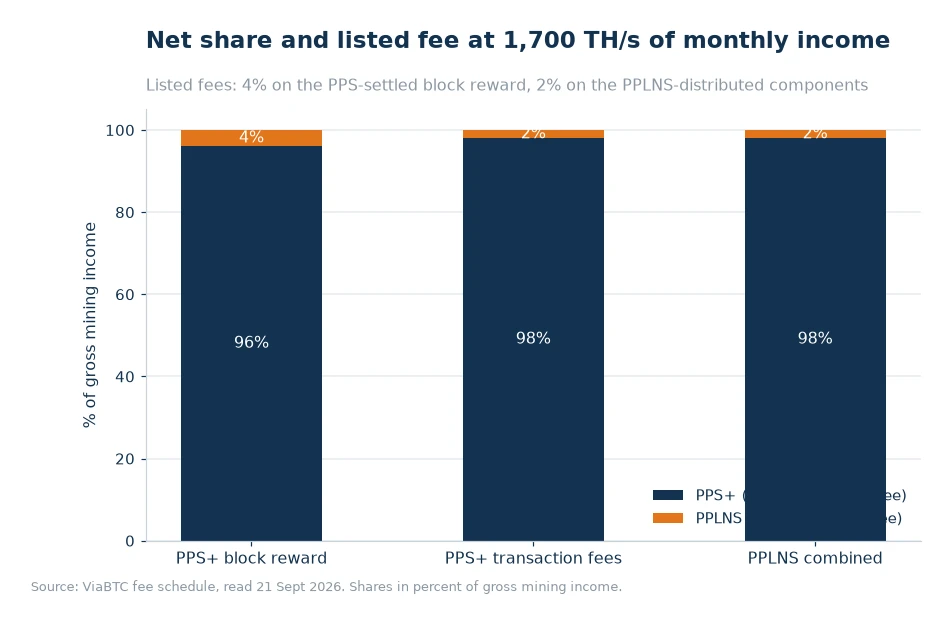
At 1,700 TH/s the gross credit is $64.59 a day at $84,692 per BTC. Under PPS+ the listed 4% on the block-reward component takes $2.58 and the listed 2% on the fee component takes $1.29; under PPLNS a single listed 2% applies to both. The percentage is the easy part. The hard part is deciding how much randomness you are willing to hold.

Key takeaways
- At 1,700 TH/s, gross income is $64.59 a day; the listed 4% line is $2.58 and the listed 2% line is $1.29.
- PPS+ pays hourly and removes pool luck; PPLNS pays after six confirmations and leaves luck with the miner.
- Match the scheme to the obligation: a fixed power bill argues for smooth credits.
- Run one week on each scheme and compare totals against the same difficulty window.
The decision is about variance, not arithmetic
Most miners compare the two schemes as if the only difference were a percentage. That framing misses what is actually being bought and sold. Under PPS+, the pool absorbs the uncertainty of block discovery and charges a listed 4% on the block-reward slice for the service. Under PPLNS, the miner keeps a larger share of each block but accepts that blocks arrive when they arrive and that the payout depends on shares contributed across the last five difficulty rounds.
So the question is not which scheme is cheaper in a good month. It is which scheme keeps the operation solvent in a bad one. A miner with cash reserves and no fixed obligations can afford to wait for the law of large numbers to smooth things out. A miner paying a power bill on a fixed date is buying predictability, and predictability has a price printed on the schedule.
What the miner hands over under PPS+
Two things leave the miner's side of the ledger: pool luck and block timing. In exchange, credits arrive hourly against current difficulty, which means the balance grows in small increments and a missed hour is immediately visible. The block-reward slice is charged the listed 4%, and the transaction-fee slice is distributed under PPLNS logic at a listed 2%, so the total deduction depends on the fee share of gross income.
That split is worth understanding before signing up, because the ViaBTC Pool Fees page sets out two components rather than one rate, and the effective rate is therefore not fixed. In a quiet mempool, the fee slice is small and the blended deduction sits close to 4%. In a busy week, the fee slice grows and the cheaper 2% applies to more of the total, pulling the blended number down. The published figures are ceilings on each component, not a flat charge on everything.
What the miner waits for under PPLNS
PPLNS pays after a block reaches six confirmations and shares the miner's slice over the previous five difficulty rounds. The first payment after switching therefore arrives later than an hourly credit would, and its size reflects a window rather than a single hour. Once the scheme is running, receipts continue, but their spacing follows the pool's block discoveries rather than the clock.
A miner who joins during a long gap between blocks may wait noticeably longer than expected for the first credit. That is not a malfunction; it is the scheme working as designed. The compensation for the wait is the lower listed rate and the fact that a lucky stretch is kept rather than shared with a pool that has promised smooth payments.
Match the plan to the obligation
Write down the outgoing payments first. Power, rent, a loan instalment, a technician's salary: each has a date and an amount. If the total is close to the incoming credit, hourly settlement is the safer structure, because a two-day gap in receipts can force a sale of coins or a late payment. If the outgoing total is comfortably below the credit, the extra return from PPLNS is worth the irregularity.
The second consideration is scale. A single 1,700 TH/s account sees wider percentage swings from luck than a farm ten times its size, simply because its share of the pool is smaller. At the small end, variance is a real budget item; at the large end it averages out within the month. That is why two operators with the same hardware can reasonably choose different schemes.
A one-week test before committing
Run the account on one scheme for seven full days, record the daily credit, then switch and run the other scheme for seven days. Compare totals, but also compare the worst single day and the longest gap between credits. The totals will differ partly because difficulty moved and partly because luck moved; the shape of the series is what you are judging.
Keep the test honest by holding hashrate constant, noting the difficulty at the start and end, and excluding any hardware downtime from both weeks. A test contaminated by a rebooted miner tells you about the reboot, not the scheme. The Profit Calculator gives a same-day gross figure to hold against the week's credits. Seven days is short, but it is long enough to feel whether the cash-flow pattern suits the way the operation actually pays its bills.
| Situation | Leans toward | Reason | Daily fee line |
|---|---|---|---|
| Power bill due on a fixed date | PPS+ | Hourly credits keep the incoming line smooth | $2.58 at the listed 4% |
| Reserves cover three months of costs | PPLNS | Luck is kept, and a slow week is absorbable | $1.29 at the listed 2% |
| New account, first payout needed soon | PPS+ | First credit arrives within the hour | $2.58 at the listed 4% |
| Farm with many accounts | Either, tested | Aggregate shares smooth the window | $1.29 to $2.58 |
Worked example
Price the gap between the two schemes at 1,700 TH/s, then scale it to a month.
- Network output is 450 BTC a day: 144 blocks × 3.125 BTC.
- Each terahash gets 450 ÷ 1,003,000,000 = 0.00000044865 BTC.
- At 1,700 TH/s: 0.00076271 BTC a day.
- At $84,692: 0.00076271 × 84,692 = $64.59.
- Listed 4% on the block-reward base: 64.59 × 0.04 = $2.58.
- Listed 2% on the PPLNS base: 64.59 × 0.02 = $1.29.
- The difference is $1.29 a day, or $38.70 across 30 days.
- Hourly under PPS+: 64.59 ÷ 24 = $2.69 of gross per hour, about $2.58 of it kept after the listed 4%.
Frequently asked questions
Can I switch schemes on the same account?
Yes, the scheme is an account setting rather than a hardware change, so the machines keep hashing while the payout method changes. Expect the first PPLNS credit after a switch to arrive later than an hourly PPS+ credit would.
Does PPLNS always pay more over a year?
No. It keeps a larger share of each block and carries pool luck, so a year with unlucky discovery can land below PPS+ while a lucky one lands above. The scheme trades certainty for exposure, not a fixed return.
How much does the choice cost at 1,700 TH/s?
The listed difference between the two bases is $1.29 a day at $64.59 of gross income, which is $38.70 over 30 days before any difference caused by luck or block timing.
Decide before the first invoice
Set the scheme against the calendar, not against a spreadsheet of averages. If the power bill cannot float, take the hourly credits and treat the listed 4% as the cost of a predictable month. If the operation can absorb a quiet fortnight, the lower listed rate on the combined base is there to be used.
Whichever way it goes, write the reasoning down and revisit it after a full difficulty cycle. The pool state page shows how the pool's own luck has been running, which is useful context when a PPLNS week looks strange. A scheme chosen deliberately and reviewed on schedule beats one inherited from a default setting.
Sources: ViaBTC fee schedule and pool state pages for rates, settlement rules and luck context[1]. Market inputs read 21 Sept 2026 — BTC $84,692, hashrate 1,003 EH/s, difficulty 132.76 T, 144 blocks a day at 3.125 BTC. Published 24 Oct 2026.