What to Do When the Novelty Fades
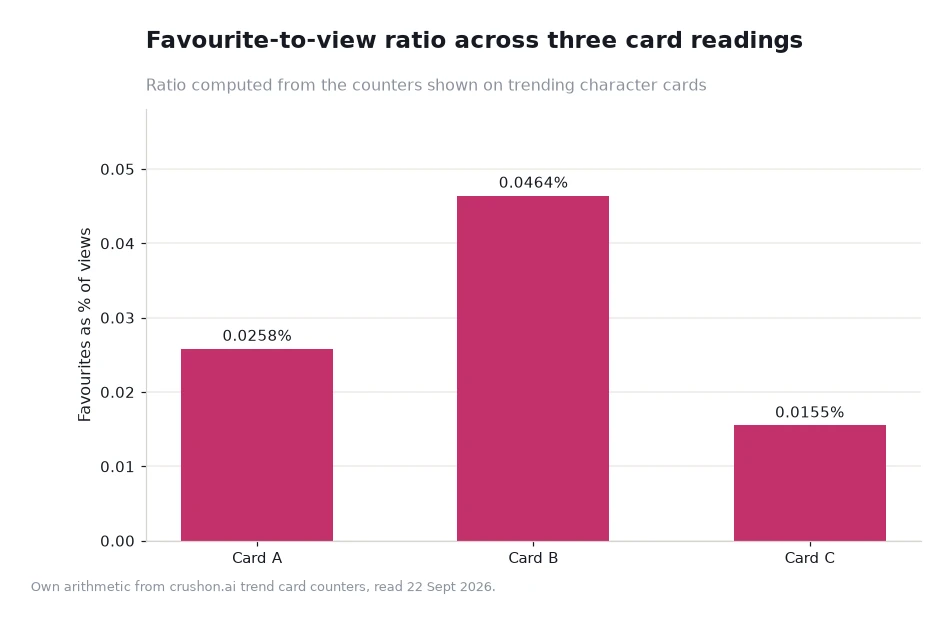
A chat going stale is almost never a platform problem, and it is usually fixable in three moves: change the character, change the register, or restart the thread with a better opening. The signals are measurable rather than mystical — when a card's replies start reading the same as every other card's, the setup is no longer doing any work. Save rates between 0.0155% and 0.0464% across trending cards suggest that plenty of readers solve this by moving on, which is one valid answer among several.

Key takeaways
- Diagnose before switching: identical-sounding replies point at a thin setup, while short replies point at thin input from you.
- Restarting a thread with a two-sentence scene costs one session and often restores more than a new card would.
- Crushon's weekly chart is rebuilt every Thursday, which gives a dated reason to look at something new once a week rather than constantly.
- Keep the list at five. A reader juggling twenty cards is sampling, not conversing.
Three kinds of stale, and how to tell them apart
The first kind is a thin card. If every reply could have come from any character in the catalogue, the problem is the setup: too little situation, no specific thing for the character to want. The fix is a different card, chosen this time by reading the description rather than the label set.
The second kind is thin input. If replies are short and the conversation keeps sliding back to its opening, the thread has run out of material because you stopped supplying any. The fix is one concrete detail per message — a place, a decision, a question with more than one answer — and it usually takes effect within three turns.
The third kind is a long thread that has outgrown its own context. After a few hundred messages, the setup that made a card distinctive is buried far behind the current exchange, and the conversation drifts toward a generic middle. The fix is a fresh session with the scene restated from the card's own description.
What to change, in order of cost
Start with the cheapest change. Restating the scene costs a single message. A new register costs one session's worth of attention: pick a card whose declared tone differs from the one you have been using, and hold that register deliberately for twenty messages. A new card costs a sampling session, and a new creator costs a shortlist review.
Only after those three does replacing the platform make sense, and the arithmetic rarely supports it. If a card reading of 0.0155% sits next to one at 0.0464%, the difference is about threefold, and that gap exists inside a single catalogue. The variety you are looking for is more likely to be two labels away than on another service.
Use the weekly reset as a cue
Twenty entries are refreshed every Thursday, which makes the chart a natural weekly reminder rather than a permanent destination. Set one fifteen-minute slot a week to check what moved, note any label combination you have not tried, and close the page. That rhythm prevents both of the usual failure modes: endless browsing and complete stagnation.
| Diagnosis | Symptom | Cheapest fix | Effort |
|---|---|---|---|
| Thin card | Replies could belong to any character | Choose a card with a written situation | One sampling session |
| Thin input | Short replies, returns to the opening | One concrete detail per message | Three turns |
| Long thread | Early details stop appearing | Restart with the scene restated | One message |
| Register fatigue | Everything sounds the same | Switch to a card with a different declared tone | One session held deliberately |
| Catalogue fatigue | Nothing on the chart appeals | Search a narrow label instead | One search, eight opens |
Worked example: what a weekly reset is worth
Take the card readings in the chart that follows: 0.0258%, 0.0464% and 0.0155%. Convert the first from counts to a rate by dividing 7,100 saves by 24,300,000 views, which gives 0.000258, or 0.0258%. Divide the strongest reading by the weakest and 0.0464 ÷ 0.0155 = 2.99, so the best card in the set converts about three times as often as the worst.
Now price the habit in time. A weekly fifteen-minute review is 15 × 4 = 60 minutes a month. Replacing that review with ad-hoc browsing three times a week at eight minutes each is 96 minutes a month, so the scheduled version saves about 36 minutes — and it is the version that actually produces a decision, because it has an end point.
Both the fifteen-minute slot and the ad-hoc figure are illustrative assumptions about behaviour rather than platform data. The point is structural: novelty fades on a schedule, so a renewal habit works better when it is scheduled than when it is hoped for.
Renewing a thread without abandoning it
The most underused move is the deliberate restart. Take the card's own description, write two sentences that reintroduce the situation in your own words, and open with those. The character's setup is still there; the restart simply moves it back to the front of the conversation where it can do its work again.
If that fails twice, the card is the problem rather than the thread, and a narrow search is the next step: the character search will show how deep a label pool really is, and the weekly rankings will show whether anything new has entered it. Between a restart and a narrow search, most stale porn ai chat threads have somewhere to go without leaving the catalogue. That is partly because a Porn Chat AI service leaves the diagnosis in plain sight: the setup is written on the card, the input comes from you, and the thread length is a number you chose yourself.
Novelty also returns without any change at all, which is worth remembering before dismantling a list. A card left alone for a month often reads better on return than it did at the point you had exhausted it, because the thread's early material has stopped competing with everything you said afterwards.
Frequently asked questions
How do I know it is the card and not me?
Try one strategic message. If adding a concrete detail produces a noticeably better reply, the thread was underfed; if the reply stays generic, the setup is thin.
Should I delete a thread I have stopped using?
There is no need. Leaving it in place costs nothing, and a restarted session lets you keep what worked while dropping the part that went flat.
Is boredom a reason to switch platforms?
Rarely. The readings here span a threefold difference inside one chart, so the variety is usually closer than a migration would be.
How often should I look at new cards?
Once a week is enough, and matching that to the Thursday reset keeps the review tied to a real change rather than to mood.
Schedule the renewal, do not wait for it
Treat staleness as a maintenance task with three levels — input, register, card — and work up only as far as you need to. Add one weekly slot for new names, keep the working list at five, and restart rather than discard when a thread goes quiet. That routine costs about an hour a month and keeps a good catalogue feeling as wide as it actually is.
Data and sources: trend card counters and the weekly chart on the Crushon trends page[1], read 22 Sept 2026; ratios are own arithmetic on those counters and the time figures are illustrated assumptions. Published for readers aged 18 and over.