How Can a Brewhouse Support Consistent Wort Production?
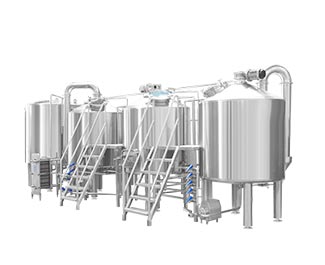
A brewhouse supports consistent wort production by keeping water volume, mash temperature, pH, lautering rate, boil-off, gravity, and knockout temperature within defined operating ranges. A mash at 65°C that varies by ±0.5°C will produce more repeatable enzyme activity than one moving several degrees between batches. Mash pH commonly sits around 5.2–5.6, while commercial wort boiling may run for 60–90 minutes with evaporation selected for the kettle design and beer specification. Consistency also depends on calibrated flow meters, temperature sensors, repeatable valve sequences, stable steam supply, sanitary pipework, and batch records that show where a deviation started rather than only recording the final gravity.
Brewhouse control starts before the mash tun is heated. If a recipe calls for 500 kg of malt and 1,500 L of strike water, a 3% water error changes the liquor addition by 45 L before enzymatic conversion begins. Malt moisture, crush distribution, water alkalinity, calcium concentration, and mash thickness then affect how quickly the mash reaches its intended condition.
A brewery therefore gets more repeatable wort when ingredient quantities are measured rather than estimated from vessel markings. Flow meters are useful for liquor dosing, while load cells or verified malt-handling records can reduce batch-to-batch differences in grist weight.
A vessel can hold the same nominal volume on every brew day while the actual quantity entering it changes because of pipe retention, foam, temperature expansion, or an incorrectly calibrated level probe.
Once water and grist meet, mixing becomes the next control point. A mash rest around 63–68°C is common for many all-malt beers, although the selected temperature depends on the intended fermentability and malt specification. A 1°C difference can change the balance of enzyme activity, so the useful measurement is the temperature throughout the mash rather than the reading beside one probe.
Agitator placement, vessel diameter, heating surface, steam pressure, and insulation affect temperature distribution. A system that reaches 66°C at the sensor while another part of the mash remains at 63°C is not running the same process twice, even when the control screen displays the same setpoint.
Mash pH adds another measurable condition. Brewing references commonly place the useful mash range near pH 5.2–5.6, with the exact target depending on malt, water chemistry, beer style, and whether the reading is taken hot or after cooling. Published brewing literature also associates this range with favorable extraction and amylase activity.
For a brewery producing 20 batches a week, a pH difference of 0.20 between batches is more informative than a single acceptable reading taken once a month. Recording pH beside temperature, water volume, malt lot, and mash time makes it easier to separate a water-treatment issue from a raw-material change.
The mash then becomes a filtration problem, so consistency depends on how evenly the grain bed forms. Grain crush that contains too much flour can restrict runoff, while a coarse crush can leave extract in larger particles. Mill gap, roller condition, malt friability, husk quality, and grist distribution therefore affect the lauter tun before the first wort reaches the kettle.
A 1,000 L brewhouse collecting wort at 8 L/min needs about 125 minutes to move 1,000 L at that rate, while 12 L/min cuts the theoretical time to about 83 minutes. Faster is not automatically better; flow must match the grain bed, false-bottom area, wort viscosity, and allowable differential pressure.
| Measured point | What a brewer can record | Example operating reference |
|---|---|---|
| Mash | Temperature, pH, time | 65°C, pH 5.3, 60 min |
| Lauter | Flow, pressure, gravity | 8–12 L/min, recipe-specific |
| Pre-boil | Volume, °Plato | 1,150 L, 11.5°P |
| Post-boil | Volume, °Plato | 1,080 L, 12.2°P |
| Knockout | Temperature, flow | 18°C, 20 L/min |
The figures above are operating examples rather than universal targets. Their value is the relationship between readings: if pre-boil volume rises by 4% while extract collected from the grain stays similar, pre-boil gravity will fall and the kettle must remove more water to reach the same specification.
Sparging needs the same level of measurement. Uneven spray coverage can form preferential paths through the grain bed, allowing water to pass through one area faster than another. A controlled sparge uses a known water volume, stable temperature, suitable pH, and a rate linked to wort runoff rather than an operator opening a valve to approximately the same position.
Brewhouse repeatability improves when the operator can compare “620 L sparge water at a recorded flow rate” with the previous batch instead of comparing two valve-handle positions.
After lautering, the kettle becomes the main volume-adjustment stage. Suppose 1,150 L of wort enters the kettle and 1,080 L remains at the end of boiling. The volume reduction is about 6.1%. If another batch begins at the same 1,150 L but finishes at 1,030 L, volume reduction rises to about 10.4%, producing a materially different concentration before fermentation.
Evaporation should therefore be measured from actual pre- and post-boil quantities rather than assumed from burner or steam settings. Kettle geometry, atmospheric pressure, heating surface, steam conditions, boil duration, wort circulation, and fouling can all alter evaporation. MBAA material has documented commercial work on lower-evaporation boiling and reported heater-cleaning intervals increasing from a normal 4–6 brews to more than 30 under a different nucleate-boiling arrangement, illustrating how equipment design can affect both thermal operation and maintenance frequency.
The kettle also has to treat wort uniformly. Internal calandrias, external boilers, steam jackets, and other systems create different circulation patterns, so identical steam pressure does not guarantee identical wort treatment. Modern wort-boiling research treats heating, boiling, and evaporation as separate process phases because each places different demands on heat transfer and circulation.
Gravity readings become much more useful when paired with volume. A batch at 12.0°P cannot be assessed fully without knowing whether the brewery produced 950 L or 1,050 L. Recording pre-boil and post-boil volume alongside °Plato allows the brewer to identify whether an apparent extract difference started during lautering or during evaporation.
For smaller systems, the same principle applies even when production is only 300–1,000 L per batch. Well-sized micro brewery equipment should provide enough measurement points to verify liquor addition, mash temperature, wort volume, heating performance, transfers, and knockout conditions without forcing the operator to estimate them from sight glasses alone.
The process then moves from concentration to solids separation. Whirlpool performance depends on inlet velocity, vessel geometry, trub quantity, rest time, wort depth, and outlet position. If a 1,000 L batch leaves 40 L behind one day and 75 L on another, recoverable wort volume changes by 3.5% of the nominal batch size before the heat exchanger is reached.
Repeatable whirlpool timing helps make that loss measurable. A brewery might standardize a defined circulation period and 15–30 minutes of settling, then record the clear-wort volume recovered. Recipes containing large hop additions may require different conditions, so comparing like-for-like recipes gives more useful production data than applying one loss target to every beer.
Cooling follows immediately, and the fermenter should receive wort at a stable temperature rather than an average temperature that hides movement during transfer. A plate heat exchanger delivering wort between 18.0°C and 18.5°C provides a much narrower starting condition than one moving from 17°C to 21°C during the same knockout.
Heat-exchanger performance depends on wort flow, coolant temperature, plate area, fouling, and pressure. If wort flow increases by 20% without a matching change in cooling capacity, outlet temperature may rise. Automated modulation of coolant or wort flow can keep the knockout condition closer to the recipe setpoint.
Sanitation influences the same measurements over longer production periods. Deposits on heating surfaces reduce heat transfer; fouled heat-exchanger plates alter cooling performance; residue inside pipework can restrict flow. A cleaning program therefore affects temperature, cycle time, pressure drop, and microbiological control at the same time.
CIP records can include solution temperature, circulation duration, conductivity, return condition, and completion status. Comparing those records over 50 or 100 brew cycles can reveal a gradual change that is difficult to see from one brew. Brewers Association guidance also treats good manufacturing practices and consistent brewing techniques as part of maintaining beer quality.
Instrumentation still needs verification because automation repeats sensor errors as efficiently as it repeats correct settings. A temperature probe reading 1.5°C low can keep an automated mash consistently above its intended temperature, while a flow meter reading 3% low can overfill mash or sparge liquor on every batch.
A practical record therefore includes both process data and calibration history. Temperature probes, pressure transmitters, flow meters, load cells, density instruments, and pH meters can be checked on scheduled intervals appropriate to their use, with any offset documented before production data is compared across months or years.
Batch records then connect the individual measurements. Instead of recording only “12.5°P into fermenter,” a useful record can contain grist weight, liquor volume, mash temperatures, pH, conversion time, runoff duration, sparge volume, pre-boil volume, pre-boil gravity, boiling time, evaporation, post-boil gravity, whirlpool loss, knockout volume, and knockout temperature.
A narrow final-gravity range is most useful when the process used to reach it is also repeatable. Two batches can both finish at 12.5°P while one uses excessive sparge water and heavy evaporation and the other reaches the same figure through normal extraction and boil conditions. Tracking the full brewhouse sequence shows the difference before fermentation begins.